
What does an unlicensed slot site look like?

You may have heard about the alarming rise of black market gambling websites. It’s a trend right across Europe as well as in the UK, and it’s showing no sign of slowing. What you may not realise is that you might be using these sites without even knowing.
One report published by the UK Gambling Commission (UKGC) suggested that, while some players simply don’t care (they should), most players who use illegal sites aren’t even aware that they’re doing so.
If such a vast proportion of illegal gamblers are under the impression that they’re using legit sites, then perhaps educating players on what to look for is the way to help them avoid the dangers of the black market.
Here’s the Slot Gods guide to spotting illegal slot sites.
Illegal vs. unlicensed
An illegal slot site is not the same as an unlicensed slot site, even if the terms are often used interchangeably. A slot site can possess licences for various jurisdictions around the world simultaneously. It only becomes illegal when they accept players from a country they’re not licensed to operate in.
Here’s an example: slot site X holds a licence from the Curaçao Gaming Control Board (CGCB), which entitles it to operate in many countries around the world. However, not all regulators consider the CGCB to be stringent enough. One such is the UKGC.
Therefore, while slot site X can operate elsewhere legally, and it can even have a website that is accessible to UK players, it cannot legally allow Brits to gamble through it. This isn’t to say that slot site X is necessarily untrustworthy; it just doesn’t meet the criteria of the UKGC, and is therefore unlicensed in the UK.
Slot site Y, on the other hand, operates in an off-shore capacity. It may or may not have licences from other regulators, but it does not have one from the UKGC. Despite this, slot site Y allows UK players to open accounts and gamble. Slot site Y is an illegal black market slot site, and it should be avoided.
Why you should avoid illegal slot sites
There are many reasons why slot sites without licences should be avoided…
- There’s no protection for players, because these sites aren’t answerable to British law.
- They may well accept players under the age of 18.
- Illegal sites have a long history of ripping off players and refusing to pay out.
- Transactions may be insecure, and personal details may not be protected adequately.
- There’s no support for problem gamblers, and often no responsible gambling tools.
- Illegal sites violate laws that are in place to protect players’ best interests.
- Games can be rigged.
- It’s unlikely they are paying tax.
Identifying illegal or unlicensed sites
There are several red flags that all players should be aware of. Below, we’ve outlined the main ones.
UKGC licence?
In most cases, slot sites will display their licence details at the bottom of their homepage. A UKGC licence number looks a bit like this: “000-012345-N-987654-001”. The Commission also requires that slot sites display their account number (six digits) and a link to their licence page on the UKGC Public Register.
If a slot site isn’t complying with these requirements, and if you can’t find it on the searchable Public Register, there’s a strong likelihood that you’re using an illegal slot site.
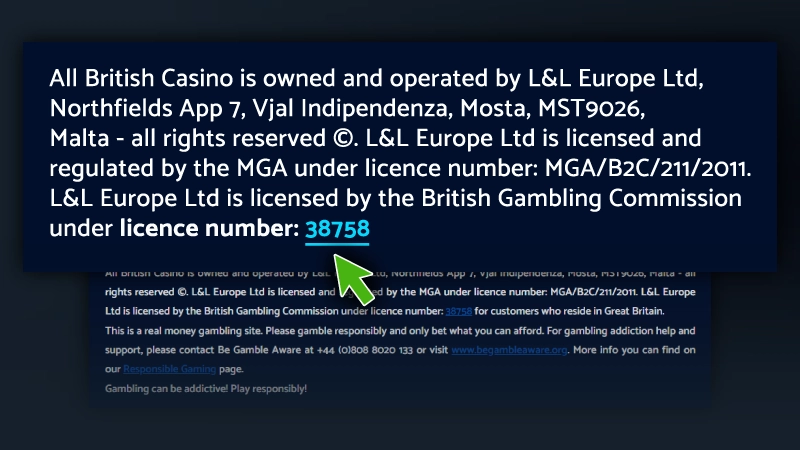 A licensed slot site will show that it is licensed by the UK Gambling Commission by having a link to the licence in the website footer.
Illicit payment methods
In the UK, it’s illegal to use certain payment methods for gambling. These include credit cards, which were made illegal for gambling deposits in 2020, and cryptocurrencies such as Bitcoin, Ethereum, Litecoin or anything similar. If a site accepts these, beware.
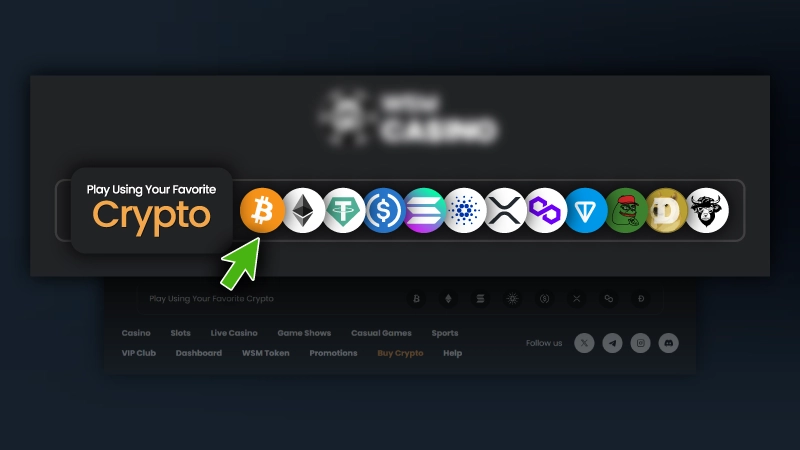 If a slot site allows the use of crypto for deposits it isn't licensed by the Gambling Commission.
Unfamiliar game library
While an illegal slot site could have all of the same games as a legit site, there are often some unknown developers on the list. If there are lots of games you don’t recognise, this could be an indicator that you’re on a dodgy website.
No responsible gambling tools
Responsible gambling tools are a legal requirement. These include things like deposit limits, time limits and self-exclusion instructions. Responsible gambling pages also contain contact information for support organisations like GamCare and GAMSTOP. If you can’t see a responsible gambling page link anywhere, proceed with caution (or don’t proceed at all).
And if you see a slot site advertised as ‘No GAMSTOP’ that is a sure sign to avoid it.
Unreasonable or unclear T&Cs
If there are any murky details in a site’s terms and conditions, you should definitely check their licence situation. Legit slot sites offer enticing bonuses, but they always present the T&Cs clearly, and in compliance with UKGC bonus guidelines. Similarly, if a slot site’s bonus terms seem too good to be true, this might hint at foul play.
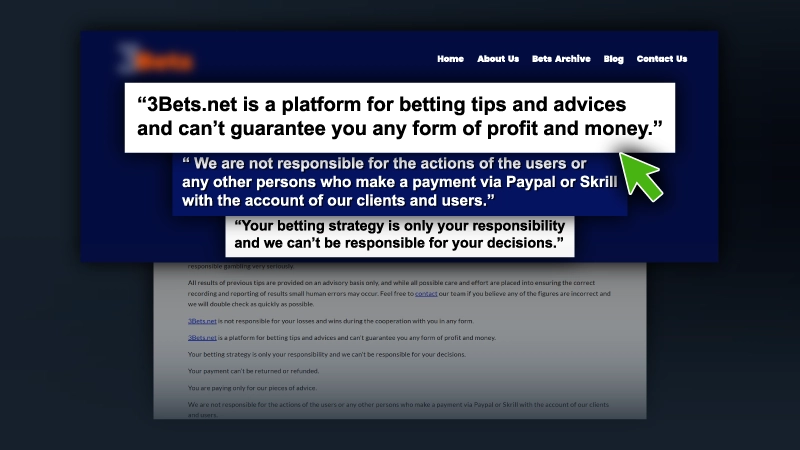 Badly written information and/or confusing or unreasonable terms and conditions.
Accessible customer support
All good slot sites have customer service who can be contacted with relative ease. Many of those that shouldn’t be trusted are faceless, with no available email address, live chat window or other means of getting in touch. If you can’t get through to a real person, or if there’s no mention at all of customer support, run for the hills.
Aggressive or sloppy marketing
Look at the way a slot site presents itself. If the marketing messages and on-site copy are riddled with typos and spelling mistakes, this is bad news. If they spam your inbox with messages, or if you’re getting unexpected emails from other slot sites, this can also be a telltale sign that you’re playing with fire.
No collection of ID or age verification
It’s a legal requirement that UK-licensed slot sites complete KYC (Know Your Customer) checks, as well as AML (anti-money laundering) checks. If you haven’t been asked to provide personal information or ID to verify your age, you’re probably on an illegal platform.
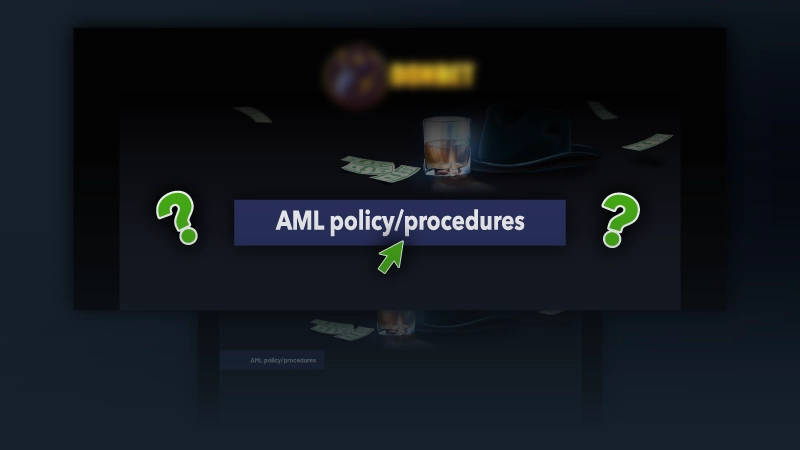 This slot site had a link to their Anti-Money Laundering policy. Clicking on that link showed they didn't actually have one.
Wider dangers of the black market
We’ve mentioned some of the personal reasons that players should avoid black markets, but this problem goes beyond the personal.
Damages the legitimate industry
Black market slot sites make the legitimate market less viable, which is economically damaging to the many countries being affected. Governments lose out on money that is earmarked for programs intended to help society. Legitimate gambling businesses and their employees are also negatively affected by a growing illegal market.
No £s for the public purse; lines crims' pockets instead
Instead of benefiting the country, money spent at illegal sites is effectively being siphoned off, into the pockets of criminals. Many black market sites have known associations with fraudulent activities such as money laundering, as well as even more sinister ones like drugs and people trafficking.
Reporting illegal slot sites
Have you come across an illegal site, or maybe one that you suspect is up to no good? The UKGC has a system that you can use to anonymously report it. All you need to do is open the ‘Tell us something in confidence’ page, click ‘Start’, and complete the forms. It doesn’t take long, and it’s well worth doing, for the benefit of other players, for the industry and society as a whole.
Summary
Because of its limited powers, the UKGC can’t easily take down illegal sites, and they can pop back up quite quickly. For this reason, they’re not going away any time soon. With so many risks and reasons not to lurk in these shady corners of the internet, players are strongly advised to remain on the legal side of things. If you want a bit more guidance, you could check out our guide to spotting the perfect online casino.